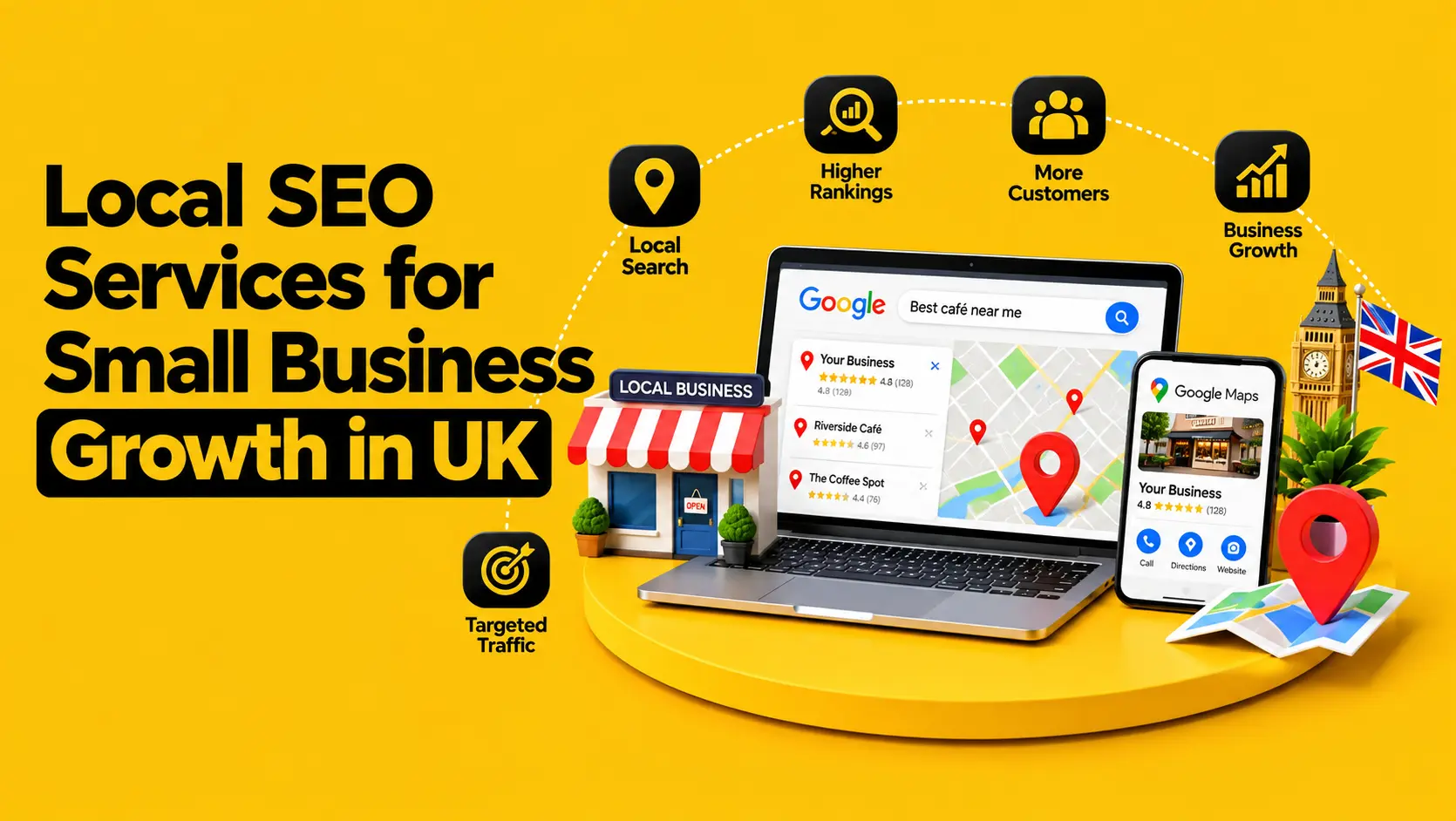
If your business serves a specific town, city or region, ranking for generic searches is only half the battle. The real opportunity is appearing when someone nearby is ready to call, visit or buy.
That is where local SEO for small business comes in.
For a plumber in Manchester, a solicitor in Leeds or a restaurant in Bristol, being visible for “near me”, service-plus-location searches and Google Maps can directly influence enquiries. Yet many small businesses still have incomplete Google Business Profiles, weak location pages or inconsistent business information online.
This guide breaks down what actually matters, what you can handle yourself, and when investing in local SEO services for small business makes financial sense.
Key Takeaways
- Google Maps visibility matters. Your Business Profile is more than an online listing, it is a major local search asset.
- Location needs to be built into your website. Service pages, location pages, internal links and structured data help Google connect your business with local searches.
- Reviews and local authority can move the needle. Genuine reviews, citations and relevant local links strengthen trust and prominence.
- SEO budgets should match the job. Local campaigns in the UK commonly start around £300-£800 per month, but the right budget depends on competition and scope.
What Is Local SEO Marketing?
Local SEO marketing is the process of improving your visibility in geographically relevant searches.
Instead of trying to rank nationally for “accountant”, for example, a Birmingham accounting firm may target searches such as:
- accountant in Birmingham
- small business accountant Birmingham
- tax adviser near me
- self-assessment accountant Birmingham
Google says local results are primarily influenced by relevance, distance and prominence. Relevance determines how closely your business matches the search, distance considers proximity to the searcher, and prominence reflects how established or well-known the business is.
That means local SEO is not simply putting your town name into every page. It is about building enough relevant signals for Google to understand what you do, where you operate and why customers should trust you.
The Local SEO Basics You Shouldn’t Ignore
- Start With Google Business Profile. But Do More Than Fill It In
For most local businesses, Google Business Profile (GBP) should be the first priority.
Claim and verify the profile, then make sure your:
- Primary category accurately describes your core service
- Secondary categories are genuinely relevant
- Business name matches your real-world branding
- Address and service area are accurate
- Opening hours are current
- Phone number and website are correct
- Services and business description reflect what you actually offer
- Photos represent the real business
Google specifically states that complete and accurate Business Profile information makes a business more likely to appear for relevant local searches.
Do not treat GBP as a one-time setup either. Add appropriate photos, keep information updated and monitor customer actions such as calls, website visits and direction requests.
And be careful with reviews. The UK’s Competition and Markets Authority says 89% of consumers use online customer reviews when researching a product or service, with online reviews potentially influencing £23 billion in UK consumer spending each year.
The goal isn’t to collect dozens of artificial five-star reviews. Ask genuine customers for honest feedback and respond professionally, including when the review is negative.
- Build Your Website Around Local Search Intent
A well-optimised Business Profile cannot compensate for a website that gives Google very little useful information. Your website should have clear pages for the services and locations that matter commercially.
For example, a London-based electrician might structure its site around:
- /electrical-services/
- /emergency-electrician/
- /electrician-hammersmith/
- /electrician-kensington/
Each page should offer genuinely useful, location-specific information rather than swapping the town name into the same template.
This is where SEO for small businesses often goes wrong. Businesses create ten near-identical location pages because they want to rank in ten towns. Google has little reason to show thin, repetitive pages.
Instead, build pages around real search intent.
Include:
- What services you offer in this area
- The areas or postcodes you serve
- Questions of local customers
- Pricing information for relevant services
- Testimonials by your local customers
- Calls to action
- Interlinks within service and location pages
- Don’t forget about technical SEO
Technical SEO still plays an important role in your local presence.
Make sure your site has good:
- Mobile usability
- Core Web Vitals
- Indexability
- XML sitemap
- Canonical URLs
- Broken link check
- Page titles and meta descriptions
- Internal links
- HTTPS
- LocalBusiness schema markup
LocalBusiness schema markup can help search engines know more about your business type, address, business hours and other contact details. However, it is not a magic formula for ranking high in local results; this markup just helps search engines understand more about your business.
- Build Local Authority Through Reviews, Citations and Links
Google doesn’t consider your website alone when evaluating your online presence.
Your business information can come from your website, third-party sources, users and other publicly available information.
That makes NAP consistency like Name, Address and Phone number important. Your core business details should be consistent across relevant directories and platforms.
For a UK business, that might include relevant:
- Industry directories
- Local business directories
- Professional associations
- Chamber of Commerce listings
- Trade organisations
- Local publications
But don’t chase hundreds of low-quality directories just to increase a backlink count.
A handful of relevant local links can be much more useful. Think local newspapers, community organisations, suppliers, professional associations, sponsorships and genuine partnerships.
Reviews matter here too. Google confirms that reviews and links from other websites can contribute to prominence in local search.
So if a local competitor has 200 reviews and strong mentions across reputable local websites while your business has five reviews and little online presence, publishing another generic blog post probably isn’t your biggest SEO opportunity.
- Measure Enquiries, Not Just Rankings
Ranking reports can look impressive while the phone remains suspiciously quiet. For small businesses, local SEO should ultimately connect visibility with business outcomes.
Track:
- Google Business Profile calls
- Website clicks
- Direction requests
- Organic traffic
- Local keyword rankings
- Contact-form submissions
- Phone enquiries
- Conversion rate
- Leads by location or service
Use Google Search Console to identify search queries, clicks, impressions and average positions. Connect it with analytics and your CRM where possible so you can see what happens after someone finds you.
For example, ranking #2 for “emergency plumber Manchester” is useful. But knowing that the page generated 24 qualified enquiries in a month is far more valuable when deciding where to invest next.
How Much Do Local SEO Services Cost?
There isn’t one fixed price because local SEO can mean anything from a basic Business Profile setup to an ongoing technical, content and authority-building campaign.
Current UK pricing guides put local SEO for a single location at roughly £300-£800 per month, while broader small-business SEO commonly falls around £500-£2,000 per month. These are market ranges rather than official industry rates.
As a rough guide:
| Monthly Budget | What you might expect |
| £300 – £500 | GBP Optimisation, citations, basic on-page work and reporting |
| £500 – £1,000 | Local SEO plus content, technical improvements and stronger optimisation |
| £1,000 – £2,000+ | Competitive markets, multiple locations, deeper technical SEO, content and authority building |
The cheapest option isn’t automatically the best value. Ask what work is actually included, which pages will be improved, how links are acquired and which KPIs will be reported.
How Much Should SEO Cost for a Small Business?
Your SEO budget should reflect competition, location, number of services, number of locations and the current condition of your website.
A single-location independent business competing in a low-competition area does not need the same investment as a law firm targeting London.
A sensible SEO proposal should therefore start with an audit and strategy, not a generic package copied from another business.
Can I Do Local SEO Myself?
Yes. You can handle many fundamentals yourself.
Google Business Profile setup, review requests, basic on-page optimisation and keeping your business information accurate are all realistic DIY tasks.
The difficulty comes when you need technical SEO, competitor analysis, content planning, structured data, local link acquisition or ongoing performance analysis.
If you’re comfortable working with Search Console, analytics, keyword research and website CMS tools, DIY local SEO can work. If you’re spending several hours every week trying to work out why your competitors outrank you, professional local SEO services for small business may be a better use of your time.
Why Local SEO Is Worth Considering in the UK
The UK had 5.7 million private-sector businesses at the start of 2025, including 5.64 million small businesses with fewer than 50 employees.
Competition for local customers is not going away. And with Google reaching 83% of UK online adults in May 2024, search remains a significant route to finding businesses.
The opportunity isn’t to “do more SEO” for the sake of it. It is to be visible for the searches that have a realistic chance of turning into customers.
The Bottom Line
Local SEO works best when it is treated as a revenue channel rather than a ranking exercise. A strong Google Business Profile gets you into the local search conversation.
A properly structured website gives Google more reasons to connect your services with specific locations. Reviews, citations and relevant links build credibility. And proper tracking tells you whether all that work is actually generating enquiries.
For small businesses, that combination matters more than chasing hundreds of keywords.
If your business serves customers in specific UK locations and you’re struggling to turn search visibility into consistent enquiries, Xparro can help you build a local SEO strategy around the services, locations and customers that matter most.
FAQ
1. How much do local SEO services cost?
In the UK, local SEO can cost around £300-£2,000+ per month, depending on your location, competition and goals. A single-location business usually needs less than a business targeting multiple areas.
2. Can I do local SEO myself?
Yes. You can manage your Google Business Profile, reviews, local keywords and basic on-page SEO yourself. As your competition grows, professional local SEO services for small business can help with technical SEO, content and link building.
3. What is Local SEO Marketing?
Local SEO marketing helps your business appear when people search for services in their area. It combines Google Business Profile optimisation, local content, reviews, citations and website SEO to bring in more relevant local customers.
Leave a Reply